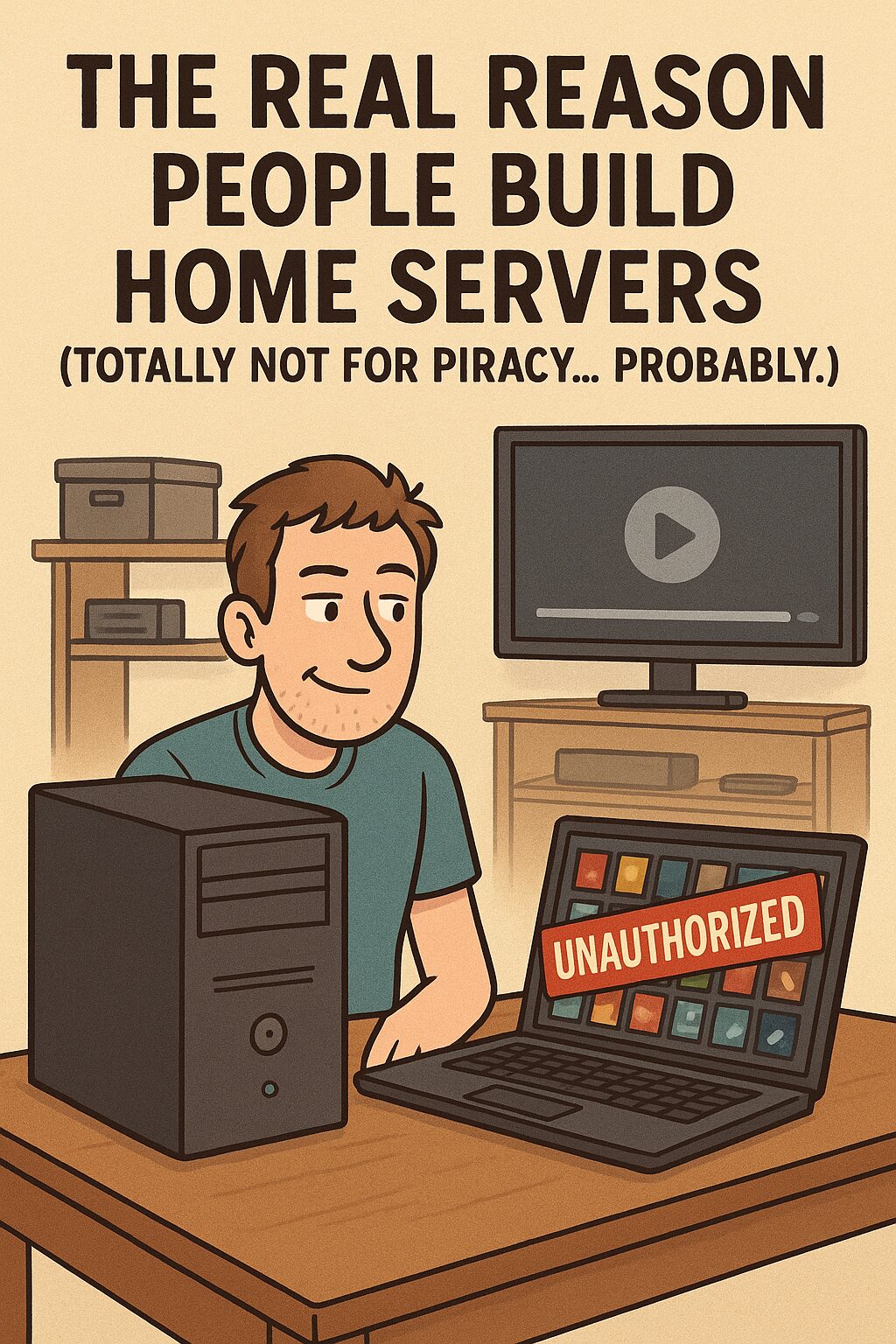
The Real Reason People Build Home Servers (Totally Not for Piracy… Probably.)
Let’s be honest. Every time someone in a forum claims they built a home server “for backups,” the entire internet collectively rolls its eyes so hard it threatens to go off-axis. Yes, Tim, I’m sure your 72 terabytes of meticulously organized storage are exclusively for nightly snapshots of your tax documents.
They totally exist for one reason… and it’s not to archive the family photos.
The Sacred Ritual of Pretending It’s for “Productivity”
Ask any home server enthusiast what they use their hardware for, and you’ll hear the same solemn chant:
- “Automation!”
- “Backups!”
- “Self-hosting productivity tools that I absolutely use daily and didn’t forget about three weeks after installing!”
They say all this while sitting next to a tower of enterprise-grade drives clicking ominously like a digital Stonehenge.
Meanwhile, Plex is running in the background with enough 4K HDR content to make Netflix rethink its business model.
But no piracy here! Absolutely none. Those files all came from mysterious legal sources that we do not question.
ZFS for… What Exactly?
Home server folks absolutely love extolling the virtues of ZFS:
- Checksumming!
- Self-healing data!
- Snapshots!
And yes, these things are genuinely amazing. But let’s not pretend ZFS’s real job isn’t protecting an 11-season remux of a show that was canceled in 1997 and never released on Blu-ray.
Because sure, losing your wedding photos would be sad…
But losing season 4 episode 13 of “Obscure Sci-Fi Show With a Cult Following”?
Unacceptable. Civilization-ending. Rebuild-the-array-from-scratch-level tragedy.
The 10GbE Backbone—For Efficiency, Right?
Ask a home server builder why they need 10 gig networking, and they’ll explain:
“It’s essential for my virtualized workflow and multi-user document editing.”
Uh-huh. Sure.
It has absolutely nothing to do with streaming a 120GB 4K IMAX rip to the living room without buffering.
Definitely not.
Docker: The Enabler of Denial
Every home server inevitably becomes a shrine to Docker containers:
- Sonarrr
- Radarr
- Bazarr
- Lidarr
- Readarr
- Basically anything ending in “-arr,” like a pirate talking about automation
But no, these apps aren’t for piracy. They’re for… organizing files.
Just totally random files that coincidentally align perfectly with one’s tastes in movies, TV, books, anime, comics, and the entire Criterion Collection.
It’s uncanny, really.
Redundancy for the Important Stuff — Not the Important Stuff You Think
RAID. Backup drives. Off-site storage. Cloud replication.
All of it, according to home server users, is to “protect critical data.” When asked what “critical data” means, they respond:
“You know… stuff.”
Meanwhile, 15 different drives hum in harmony, redundantly storing 93TB of “stuff” that looks suspiciously like the entire filmography of Hollywood from 1982–2017.
Conclusion: It’s Definitely Not Piracy. It’s Archival Enthusiasm.
Let’s give home server geeks some credit—they’re passionate, dedicated, wildly over-engineered archivists of… culture.
Sure, the average person’s entire digital life could fit on a 128GB USB stick, but that’s not the point.
The point is that home servers aren’t built for piracy.
Piracy is illegal and wrong.
Home servers are built to…
- Host imaginary productivity apps
- Backup PDFs that don’t exist
- Stream “personal media collections” that happen to be identical to Netflix’s catalog
- And maintain the world’s most overkill infrastructure for watching a TV show from 2005 “the way the creator intended”